

Dart 18 World Championship 2026
Published 17:21 on 4 Aug 2026
The French have a habit of giving things names that sound as though they ought to mean something profound, and Les Alignements is no exception. It refers, in fact, to the famous Neolithic stones at Carnac, standing in military precision after several thousand years, presumably because nobody had yet thought to appoint a race committee.
The title, however, seemed equally appropriate for another form of alignment altogether: that of one hundred and forty Dart 18s attempting to arrange themselves on a start line somewhere off the coast of Brittany. Members of Worthing Sailing Club may imagine this to be a comparatively straightforward undertaking. It is, provided one has overlooked a small but significant detail.
Wind.
Without wind, the business resembles trying to organise a cavalry charge using ornamental garden snails.
Thus it came to pass that the Dart 18 World Championship of 2026 descended upon Carnac to celebrate the class's fiftieth anniversary. No fewer than ten boats from Worthing made the pilgrimage, encouraged by glossy forecasts promising a civilised ten to fifteen knots and by the comforting knowledge that Carnac also lays claim to being the oyster capital of the world.
Opinions on oysters have always divided mankind almost as effectively as religion or politics. Some people consume them with expressions bordering upon religious ecstasy. Others regard them as a practical joke perpetrated by the sea upon the unsuspecting diner. Having sampled a respectable number during the week, I remain uncertain into which camp I fall, although I can confidently report that they become appreciably more attractive after several hours drifting about in the sun with nothing else to think about.
Now, before anybody imagines that the following observations are intended as criticism of the Dart 18, let me say at once that it remains one of the most ingenious little boats ever devised. Portable enough to tow behind an ordinary car, simple enough to rig without consulting an engineer and fast enough to remind one, when the breeze eventually appears, why one spent the better part of five hundred pounds entering the Championship in the first place.
That figure, naturally, did not include accommodation for my daughter Armelle and myself, ferry crossings, fuel, food and the innumerable financial pinpricks that accompany any sailing expedition abroad. By the time the arithmetic had finished with me, I reflected that it might have been cheaper to buy Brittany outright.
Not that I regretted it. I had visited the Gulf of Quiberon before and retained agreeable memories of wandering around the immense U-boat pens at Lorient, monuments to a period when considerably larger craft than Dart 18s occupied the local waters. I had been looking forward to returning ever since.
The journey south was like motoring through a history textbook. Caen. Villers-Bocage. St-Lô. Dieppe. Rouen, where the English, never knowingly outdone in poor public relations, managed to turn Joan of Arc into a French national treasure. France, I was reminded, is not merely a large country; it is a country determined to remain large for mile after mile while obliging one to drive on the right-hand side of the road in a vehicle approximately the dimensions of a suburban bungalow.
Our accommodation was at Camping Dolmen, a name I had previously regarded as pleasantly rustic until somebody explained that a dolmen is, in essence, a prehistoric tomb. One does not normally choose holiday accommodation whose principal selling point appears to be that people have been buried there for five thousand years, but by then it was too late to negotiate.
Besides, there were other matters pressing upon the attention.
The heat, for example.
It was not merely hot. It was the sort of heat that causes sensible people to abandon physical activity altogether and encourages race officers to stare wistfully at flags hanging limply from poles, hoping that optimism alone might generate a breeze. One gradually formed the opinion that the local weather obeyed a private set of physical laws known only to Brittany and possibly one retired meteorologist.
The competitors' briefing was held in a marquee whose internal temperature suggested that somebody had mistaken it for a commercial pizza oven. We entered in the hope of learning something useful about the course. We emerged knowing little more than when we had gone in.
This was, admittedly, partly our own fault.
Like many experienced sailors, we had not read the Sailing Instructions. They existed somewhere inside the Championship website in the form of a PDF requiring eyesight usually associated with peregrine falcons. Fortunately, Armelle's French is considerably better than mine, chiefly because it happens to be her first language. Unfortunately, even she emerged from the briefing looking as though she had accidentally attended a lecture on quantum mechanics.
We did, however, establish that one lap was signified by a red circle, two by a white circle and three by the Tricolour. Curiously, there appeared to be no flag for "No laps because there isn't enough wind to begin the first one." This omission struck nobody as significant at the time.
It would.
There Was Wind... Allegedly
Never mind that we missed the practice. It had been one of those interminable affairs involving earnest discussion, much chin-stroking and an alarming amount of hard work, all of which dragged on far beyond the point at which decent people ought to have been afloat. There was, however, consolation of a sort. Being the only Irish boat in the fleet, we had the National Prize sewn up, provided we managed the rather technical requirement of actually finishing.
Hitherto my acquaintance with catamarans had consisted of launching them in the straightforward manner favoured by sensible sailors - push the thing off the beach and let Neptune sort out the details. This business of launching via what the cognoscenti referred to as The Toilet promised to be a novelty.
Everything was prepared. The breeze was on the light side, but the officials wore expressions of quiet confidence, and one assumes they knew what they were about. The tide was obligingly out, so launching appeared to present no obstacle whatsoever.
That, naturally, was when the rudder declined to lock.
Closer inspection revealed that the rollers had escaped from their guides with all the enthusiasm of schoolboys hearing the last bell of term. The spare was a trifling three kilometres away. Up the slipway we went.
Fate, who had been following events with mounting interest, now entered the proceedings. An unsuspected pothole took violent exception to one of our wheels. There followed a prolonged hissing noise. At first we blamed the pothole. It transpired that the tyre was the one doing the hissing.
Plan A had evaporated. Plan B had gone the way of all flesh. We were now operating under Plan C without ever having reached the water. By the time we finally launched, the best part of an hour had disappeared. The remaining 136 boats were no longer competitors so much as tiny dots scattered across the horizon like an offshore wind farm.
IRL, we concluded, no longer stood for Eire. It had become Irredeemably Running Late.
An hour and a half after everyone else, we eventually hoisted sail and headed south, a solitary Dart 18 wandering across the Bay of Biscay in search of both wind and purpose. Forty minutes passed in lively debate concerning the curious geometry of a collection of objects on the horizon. They seemed oddly bunched together and, more remarkably, appeared to be making no progress whatsoever.
As we approached, enlightenment dawned.
They were making no progress whatsoever.
Yesterday's race had not, in fact, started. There had merely been what might generously be described as an attempt.
The next several hours are best remembered as an eight-hour demonstration of what it must feel like to spend the afternoon on a lilo. Every now and then a committee boat would emit encouraging noises, the fleet would drift in hopeful circles, and everyone would stare accusingly at the complete absence of wind.
Eventually a horn sounded with an air of finality. One hundred and forty boats lurched into motion on a leg described in the sailing instructions as "windward" with commendable optimism. We simply followed the leaders, reasoning that somebody among them probably knew where the windward mark was.
Amid this magnificent slow-motion mêlée there were familiar faces everywhere.
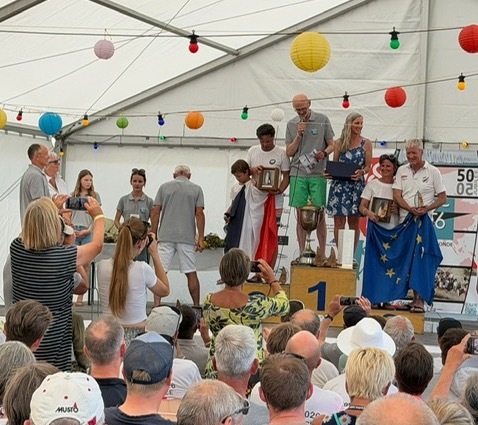
There was Rob and Fi, eventually occupying the podium while Fi hoisted the European Union flag to enthusiastic applause from everyone who wasn't British.
There were Caleb and Chloe, forever discovering fresh and imaginative ways of enjoying themselves, whether swimming, diving or apparently operating from a trailer of improbable proportions. They too were a top ten finisher
There were James and Josh, relative newcomers by Worthing standards, though already looking perfectly at home - even if, on occasions, a paddle might have proved the faster means of propulsion.
There were Sawadee D Lloyd and Jojo, complete with Thai flags and good humour.
There were Rod and Sarah, sailing well outside what most would regard as a comfortable wind range.
There were Nigel and Vicky, Nigel proving almost as accomplished on the dance floor with Mel as he was on the water.
There were Barry and Debs, requiring no starting horn whatsoever to cope expertly with conditions in which the wind was more rumour than reality.
There were Mercedes and Stony, proudly flying the sole Spanish sail number and investing enormous effort in the honourable pursuit of finishing penultimate.
There were the author and his daughter Armelle, also rans attempting to propel their Dart on oysters rather than wind. For them the week became less a regatta than a delightful holiday under the banner of Irretrievably Running Late.
There was Matt, conducting what appeared to be an entirely separate motorbike tour of France.
There were Harvey and Rowan, quietly and efficiently getting on with the business in a most reassuringly competent fashion.
Meanwhile, ashore, the wise contingent had plainly backed the correct horse. Debbie, Jo, Richard and Mel appeared to be enjoying themselves considerably more than those of us marooned upon a motionless sea.
Carnac itself was impossible not to admire. Every street seemed lined with restaurants, each offering oysters in enough varieties to satisfy the most demanding epicure, while the cafés somehow contrived to make lingering an art form.
There was the occasional excitement: a broken paddle, a black flag, a 7 a.m. launch and, by some miracle, enough breeze from time to time to complete an actual race.
There was also The Tree beside the dock, dispensing precious shade to a steadily growing congregation of discontented mariners, conveniently adjacent to The Cow, whose ice cream vanished at a rate suggesting that cold cakes are, after all, a perfectly respectable commodity.
Some of us escaped long enough to visit the remarkable stones of Les Alignements, which remained standing with admirable stoicism despite temperatures nudging thirty-five degrees.
There was even football. England against Mexico. France against Paraguay. The usual mixture of hope, despair and vigorous post-match analysis.
And then, with exquisite comic timing, Saturday arrived.
The day after the regatta.
The wind blew.
Toodle Pip