
Theo's ILCA Journey : Learning Fast on the National Circuit
Published 14:29 on 12 May 2026
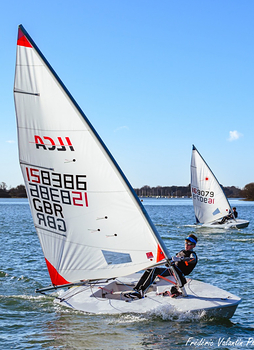
It's been a busy few months on the water and my 30-year old laser (ILCA) has been my best friend throughout the winter. Rigged with an ILCA4 set-up, she's been with me to regional and national training in Weymouth and Royal Lymington, and also to Dell Quay for the Frostbite series which had us race every other weekend from mid December to February, sometimes launching at 9am with sub-zero temperatures and an even lower windchill. All of that gave me a reasonable amount of prep for the National Opens which I had on the diary, starting in March...
Those National Opens (aka NO) brought very challenging and diverse conditions, ranging from 5-8 knots and very strong currents in Warsash, to 20-26 knots and virtually no current at Weymouth regatta.
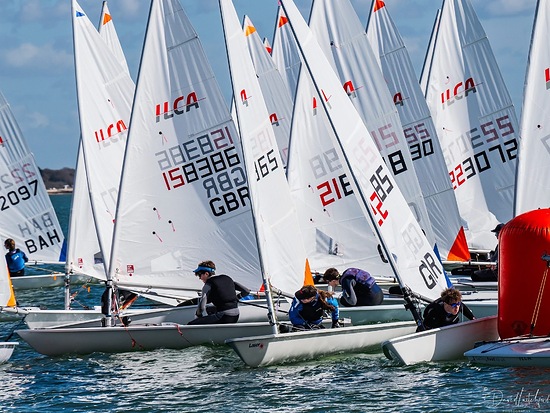
The first National Open (NO1) at Warsash was a huge learning curve for me and my fellow Worthing SC and Felpham FC mates, including Nova and Orson. The current speed was often exceeding 2 knots and it didn't help that the wind speed at the start of day 1 was very low and shifty. Nevertheless, this open taught me many important lessons (staying uptide, looking out the boat constantly, being aware of my surroundings) which I think is a key takeaway for that weekend. In the end I managed a 39th place overall (out of 69 boats), with 24th being my best race result which I was still decently happy with for my first proper national open. Big shout out to Nova and Orson who showed great endurance and resilience, as all of us spent 7 straight hours on the water, all trying to do our best.
NO2 at WPNSA also saw 69 boats on the start line, and brought similar conditions to Warsash (excluding the tide as we were in the harbour) with winds ranging from 5-10 knots on day 1 and 7-11 knots on day 2. I don't know how we got 4 races on day 1 but somehow the race committee managed to do so! The first day was not a good day for me (44th, DSQ, 39th, 20th) but still learnt a lot especially about rule 42 (propulsion). The second day brought a bit more wind albeit still with the same shifty conditions, but I managed to stay focused throughout the day giving me a 15th and a 19th on the last 2 races to conclude the open. I think I still made many avoidable mistakes which cost me many positions which, for me, is a good thing as it means I still have a lot of progress that can be made.
A week later, it was back to Weymouth for the National Open 3, which certainly did deliver with some very high wind speeds. Unfortunately on day 1 the race committee decided to abandon racing for the ILCA 4s due to gusts exceeding 40 knots. Many of us including myself were already launched and at the committee boat when we were told to go back ashore, and according to the RO we experienced our first 40+ knot wind on the way back, which was certainly a memorable experience. I managed to stay dry but only just. Day 2 was one of my best days yet in a national event. With winds ranging from 18-27 knots the conditions in the harbour were perfect for some breezy and physical sailing. I managed to come away with a 25th and a 12th placing me 14th out of 72 overall. Even though this result for me shows the progression from Warsash I still feel like I can improve significantly especially by avoiding little mistakes. I think it's Rob Garcka who told me that the winner is often the one who makes the fewest mistakes.
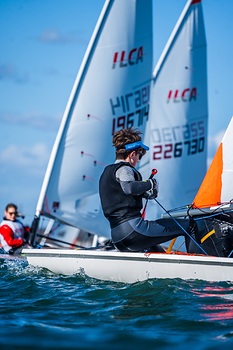
Those 3 events wrapped up a busy March, but I was soon back on the water early April for the first leg of the Regional South England ILCA Youth Series in Parkstone, which brought a variety of conditions. On the first day, the wind was very shifty and patchy with some areas of light winds and some areas of heavy winds. Day two was completely different with gusts up to 32 knots and some pretty choppy conditions. Overall, I made a few costly mistakes on the first day which did cost me the win on race one, but I still managed to come 2nd and 6th on the 2 races of the day. On day 2, I made fewer mistakes (apart from completely missing the start on the last race of the day) but boat speed was lacking a bit upwind which meant I could only manage a 2nd and a 4th, losing my second position in the last race due to count back. Still a very good weekend with a solid 3rd place overall, a trophy for best sportsmanship, and some good learning points.
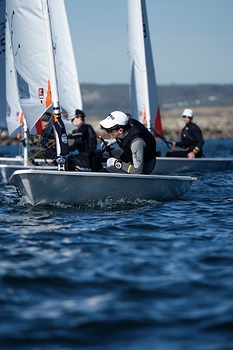
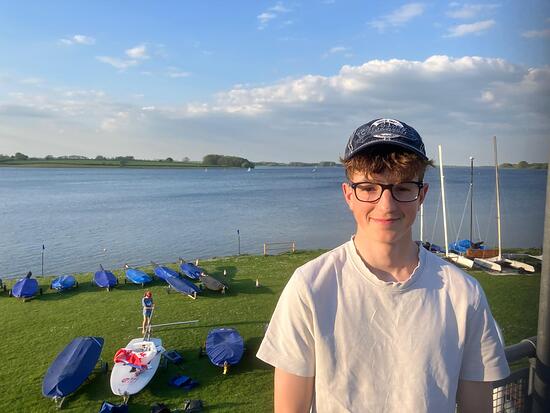
And lastly, after some further race training in April, we drove all the way to Rutland Water for the "ETs" - the RYA Eric Twiname Junior Championships - on the first week end of May. Here again there was some very shifty and light conditions across the 3 day weekend. Worth mentioning that the 48-strong fleet was a very high standard, with several entrants having sailing the European Youth championship and the Europa Cup in Spain a couple of weeks before. Day 1 was ultimately very light which meant we could only complete one race where I finished 19th due to some poor starting that I have only myself to blame for (race starts on a lake has been an entirely new experience and a huge learning curve for me on that weekend). Day 2 was a bit more windy with an average of 6-12 knots and we managed 4 races where I got 16th, black flagged, 20th and 16th... once again my starting was not ideal and in these relatively short 25-minute races a good start was key. Day 3 was slightly windier and suited me better, with an average of 8-13 knots of wind. This was by far the best day for me, due to my improvement in my starting strategy, and a bit more familiarity with read the wind shifts and oscillations more effectively which gave me a 23rd, UFD, 6, 6, 6. One key takeaway from the weekend was that pushing the start gave me huge advantages even though sometimes it meant being DSQ. Reading shifts was also key to winning races, especially in these environments, and I was pleased to improve throughout the weekend in that respect.
The big next thing on the list for me is not much to do with sailing... the GCSEs are approaching fast and it's got to take priority right now. On that topic, I'm pleased to say that I've had full marks on the sailing part of my GCSE PE practical. Many thanks to Liz, Andy, and all the DIs and SIs whom I've learned so much from over the years. I will still be sailing a little bit in May though, and really looking forward to a weekend with James Foster who's picked me together with another 5 sailors as part of a squad who will be race training in Poole under James' coaching. James is a member of the ILCA GBR squad, and it's a real privilege to learn from him. I've done a residential with him back in February at Weymouth sailing academy, and he's a brilliant coach, both on and off the water. Once the GCSEs are done and dusted, I will be heading to France, near Bordeaux, for the ILCA French Internationals. Really looking forward to that. And then the ILCA Nationals will come very quickly in July (in Weymouth again), followed by Skills Week in August (guess where?... Weymouth of course), and more training with James Foster in Poole. Also on the agenda are the next National Opens: NO4 at East Lothian, then NO5 and NO6 in Weymouth... but that won't be until September and October.
Dad and I have had quite a few people sending congratulations. This is really sweet; thank you very much for that. The ILCA circuit is tough and full of very talented sailors though. Many of them started sailing on Opi's or Teras when they were 6-7, and then moved on to Toppers, training almost daily on their local harbour or reservoir where shore dump is never a problem, and competing in so many events at national and international levels throughout the years... They have gathered an immense amount of experience already, and it's fair to say that I'm very much in catch-up mode. Being in the top 10-20 is a really big challenge, but what's much more difficult is to do it consistently, week in week out. As my dad says, the trajectory is correct, but the journey will be a long one. So it's really great to know that some of you keep an eye on how I'm getting on and shout a message of encouragement every now and again. It means a lot.
Theo